

BOMAG Compaction Equipment Service in DFW: BMP 8500, Rammers & Ride-On Rollers
Compaction equipment often works at a critical point in the job. A trench roller that will not travel, a rammer that will not start, or a ride-on roller that loses vibration can slow down more than one operator—it can hold up backfill, paving, utility, site-prep, and other work waiting behind it.
For contractors, rental yards, municipalities, utility crews, and equipment owners across Dallas-Fort Worth and North Texas, getting a BOMAG compactor back to work starts with understanding the problem and choosing the right repair path.
TexPro Equipment services BOMAG compaction equipment at its Richland Hills service shop and provides field service for equipment and repair situations that are suitable for on-site work. Some of the BOMAG models we commonly work with include the BMP 8500 trench roller, BT60 and BT65 rammers, and BW 900, BW 100, and BW 120 ride-on rollers.
Here are some of the service issues we see with these machines and what equipment owners should consider when a compactor goes down.
BOMAG BMP 8500 Trench Roller Service

The BOMAG BMP 8500 trench roller is designed for demanding compaction applications, and a problem with the machine can quickly affect jobsite productivity.
A BMP 8500 that will not start, travel, respond properly to its controls, or compact as expected does not necessarily have one obvious failure. Diagnosis may involve several systems.
Areas that may need to be inspected include:
- Engine and fuel systems
- Starting and charging systems
- Electrical components
- Hydraulic systems
- Travel and steering systems
- Remote-control and communication components
- Vibration and compaction systems
- Batteries, hoses, switches, filters, and other service components
The BMP 8500 can also experience issues involving tilt or rollover lockouts. Because safety and control systems can affect machine operation, a machine that suddenly will not operate should be properly diagnosed rather than assuming there is simply an engine or starting problem.
Structural damage is another consideration with trench rollers. These machines work in demanding environments where impacts and operating conditions can affect more than routine maintenance components. Visible damage, leaks, unusual operation, or changes in machine behavior should be evaluated before continued use.
Depending on the problem and equipment location, the BMP 8500 can be a good candidate for either field service or shop service.
BOMAG BT60 and BT65 Rammer Service
BOMAG BT60 and BT65 rammers are considerably smaller than trench and ride-on rollers, but the work they perform can be just as important to a crew.
One of the most common complaints with small compaction equipment is straightforward: the machine will not start.
A no-start condition can have several possible causes. Fuel delivery, ignition, engine condition, controls, or other components may need to be checked before determining what repair is required.
TexPro Equipment also works on BT60 and BT65 rammer issues such as:
- Recoil starter and pull-rope repairs
- Bellows or boot replacement
- Lower-end percussion repairs and rebuilds
- Engine and fuel-system problems
- Filters and other maintenance components
- General wear and preventive maintenance
The lower end of a rammer performs demanding repetitive work. Changes in percussion, unusual noises, visible deterioration around the bellows, or a noticeable change in how the rammer operates can indicate that the machine needs attention.
Because rammers are relatively easy to transport compared with larger compaction equipment, bringing a BT60 or BT65 to the TexPro Equipment service shop in Richland Hills will often be the practical repair path.
BOMAG BW 900, BW 100 and BW 120 Ride-On Roller Service

Ride-on rollers such as the BOMAG BW 900, BW 100, and BW 120 introduce another consideration: moving a down machine can itself become part of the repair problem.
Depending on the symptoms, service may involve:
- No-start diagnosis
- Engine service
- Fuel-system problems
- Electrical, starting, and charging systems
- Hydraulic systems
- Vibration and compaction systems
- Batteries and switches
- Belts, filters, hoses, and other service components
- Preventive maintenance
A roller that starts and travels but does not compact correctly requires a different diagnostic approach than one that will not start at all. Similarly, an electrical problem, hydraulic issue, engine problem, or vibration-system failure may produce very different repair requirements.
This is one reason it helps to describe what the machine was doing immediately before the problem occurred, rather than simply reporting that the roller is “not working.”
For larger and heavier rollers, field service may also eliminate the immediate need to arrange transportation before the problem has even been diagnosed.
Field Service or Shop Service for Your BOMAG Equipment?
Not every equipment repair belongs in the field, and not every down machine necessarily needs to be transported to a shop before it can be evaluated.
The right choice depends on the machine, symptoms, location, and type of repair required.
When field service may make sense
Field service can be useful when a larger machine is difficult or costly to transport, when it is down at a jobsite or equipment yard, and when the required diagnosis or repair can reasonably be performed at the equipment location.
Ride-on rollers are natural candidates to consider for field service because of their size and transportation requirements.
The BMP 8500 trench roller can be suitable for either field or shop service, depending on the problem.
Field service can also be useful for rental yards and fleet operators with multiple machines at one location. Diagnosing equipment where it sits can sometimes help determine the appropriate next step without first moving every machine to a repair facility.
When shop service may be the better option
Some repairs are better performed in a properly equipped shop.
Repairs involving extensive disassembly, structural work, major component work, or situations requiring shop equipment and a controlled repair environment may be better handled at the TexPro Equipment facility in Richland Hills.
Smaller equipment such as BT60 and BT65 rammers can also generally be transported much more easily than a ride-on roller.
If you are unsure which route makes sense, contact TexPro Equipment with the machine information, symptoms, and location. Our service team can help determine whether field service or shop service is the more appropriate starting point.
Warning Signs You Should Not Ignore
Construction equipment does not always go directly from operating normally to completely inoperable.
Sometimes there are warning signs first.
These can include:
- Difficulty starting or repeated no-start conditions
- Intermittent shutdowns
- Unusual noises
- Changes in vibration or compaction performance
- Hydraulic or fluid leaks
- Electrical or charging problems
- Controls that respond intermittently
- Unexpected lockouts
- Excessive smoke or abnormal engine operation
- Visible structural damage
- Damaged hoses, belts, boots, or other components
Continuing to operate equipment with an unresolved problem can sometimes increase the extent of the repair or create a safety concern. If a machine is behaving abnormally—particularly if there is structural damage, a significant leak, unusual vibration, or a safety/control-system issue—it may be appropriate to stop operating it until the condition can be evaluated.
Need BOMAG Parts for Your Own Repair?
Not every BOMAG customer needs TexPro Equipment to perform the repair.
Contractors with their own mechanics, rental-yard technicians, fleet maintenance departments, and equipment owners who perform their own maintenance can also contact TexPro Equipment for BOMAG parts support.
Depending on the repair or maintenance need, this can include items such as filters, belts, hoses, switches, batteries, engine-related service parts, compaction-system components, and other BOMAG repair and maintenance parts.
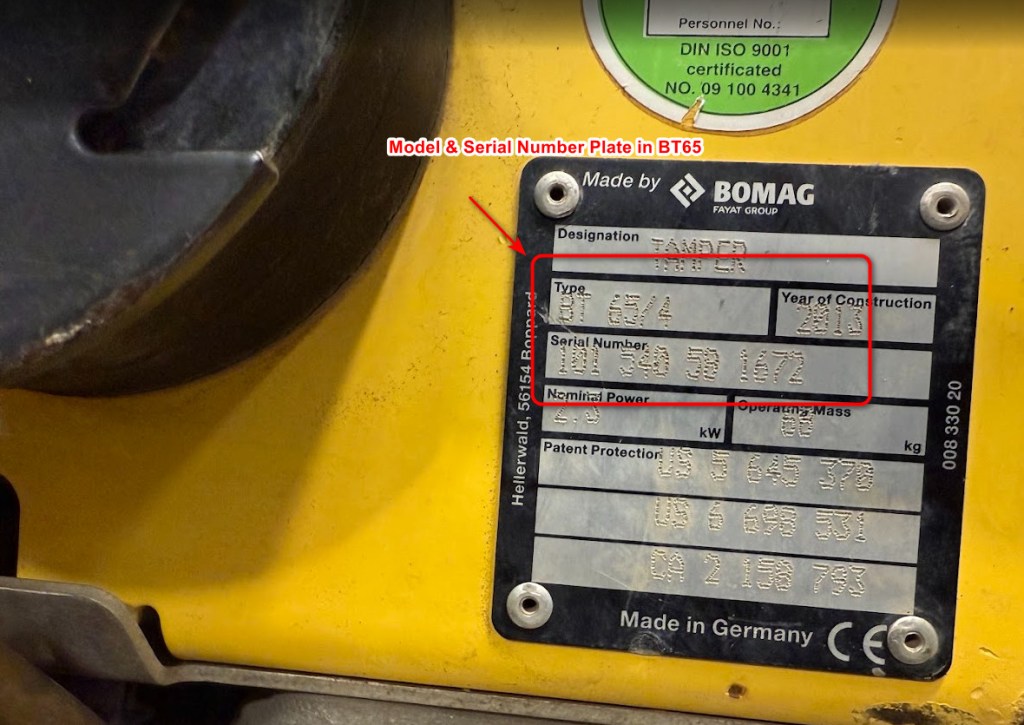
For parts requests, one of the most useful things you can provide is the machine model and serial number.
For example, knowing that a machine is a BW 120 or BMP 8500 may not always provide enough information by itself to identify the correct component. Parts can vary based on serial number, production year, engine package, and equipment configuration.
When possible, have the following ready:
- BOMAG model
- Machine serial number
- Engine information, if relevant
- Description of the part needed
- Existing part number, if available
- Photos of the component or identification plate when useful
Providing accurate machine information helps reduce the risk of ordering a part that does not match the specific equipment.
Whether TexPro Equipment performs the repair or your own mechanic does the work, our parts team can help with identifying and sourcing BOMAG parts for your machine.
What Information Should You Have Ready When Calling for BOMAG Service?
A few minutes spent gathering information before calling can make the initial service conversation more productive.
Start with the model and serial number.
Then describe the symptoms as specifically as possible.
Instead of only saying, “My BMP 8500 doesn’t work,” information such as the following can be much more helpful:
Does the engine crank? Does it start but not travel? Does the machine respond to the remote? Is the problem intermittent? Did a warning or lockout appear? Was the vibration system operating when the problem occurred?
For a service request, it helps to have:
- Equipment model
- Serial number
- Approximate machine hours, if available
- Description of the problem
- What happened immediately before the problem
- Warning lights or fault information
- Whether the problem is constant or intermittent
- Equipment location
- Whether the equipment can be transported
For a BMP 8500 with a control problem, information about the remote/transmitter and exactly how the machine responds—or does not respond—can also help the service team understand the complaint.
You do not need to diagnose the machine before calling. The goal is simply to provide enough information to establish a useful starting point.
What About BOMAG Warranty Repairs?

TexPro Equipment is an authorized BOMAG warranty service provider.
That does not mean every repair to a BOMAG machine will automatically qualify as warranty work.
Warranty applicability can depend on the particular equipment, its warranty status, the nature and cause of the failure, and applicable BOMAG warranty requirements.
If you believe your BOMAG equipment may have a warranty-related problem, contact TexPro Equipment with the model, serial number, and description of the issue. Our team can review the information and discuss the appropriate next steps before confirming whether warranty coverage may apply.
Keeping BOMAG Compaction Equipment Working in DFW
For a contractor, a down compactor can affect the work that follows it. For a rental yard, every day a machine remains unavailable can affect fleet utilization. For municipalities and fleet operators, an unresolved equipment problem can interfere with schedules and available fleet capacity.
The objective should not simply be to replace a part. It should be to identify what is causing the problem and determine a practical repair path.
TexPro Equipment supports contractors, rental yards, municipalities, utility crews, site-prep companies, paving contractors, and other construction equipment owners throughout Dallas-Fort Worth and surrounding North Texas areas with BOMAG equipment service and parts support.
Whether you have a BMP 8500 trench roller, BT60 or BT65 rammer, BW 900, BW 100, BW 120 ride-on roller, or another BOMAG machine, contact TexPro Equipment with your model, serial number, symptoms, and equipment location.
We can help determine whether field service or shop service makes sense for the repair, assist with BOMAG parts for your own maintenance or repair, and discuss potential BOMAG warranty service when applicable.



Leave a Reply