

Concrete Saw Terminology: 33 Common Terms and Their Meanings
Whether you operate a handheld cut-off saw, walk-behind concrete saw, or wall saw, understanding concrete cutting terminology can help you choose the right equipment, select the correct diamond blade, and avoid common cutting problems.
This glossary explains 33 common concrete saw terms and their meanings, including blade components, diamond segment types, cutting methods, concrete joints, and equipment types. Each definition is kept straightforward so that both new operators and experienced construction professionals can use it as a quick reference.
Table of Contents
- Concrete Saw and Diamond Blade Terms
- Concrete Cutting and Joint Terms
- Types of Concrete Saws
- Cutting Methods and Safety Terms
- Frequently Asked Questions About Concrete Saw Terminology
1. Concrete Saw and Diamond Blade Terms
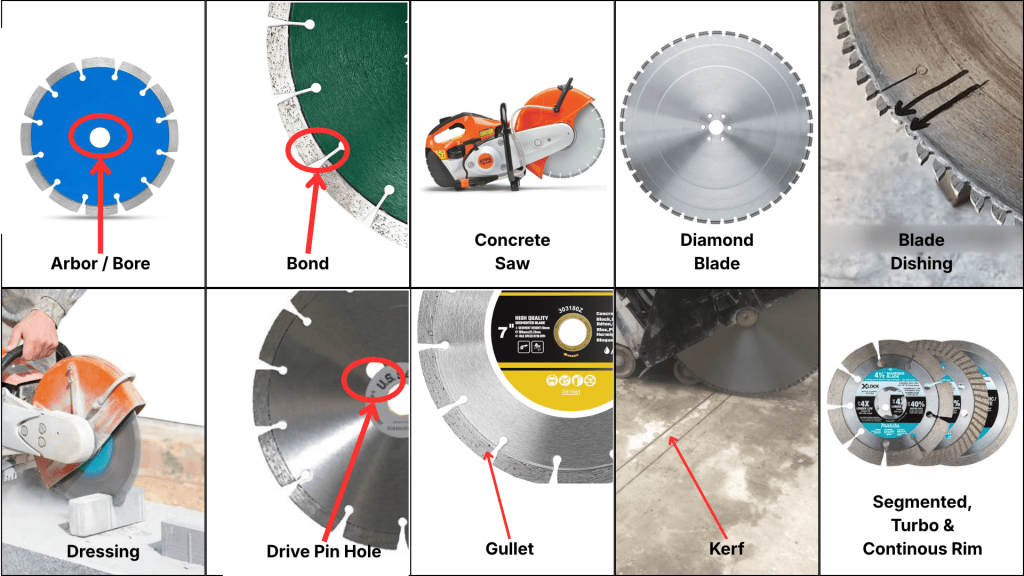
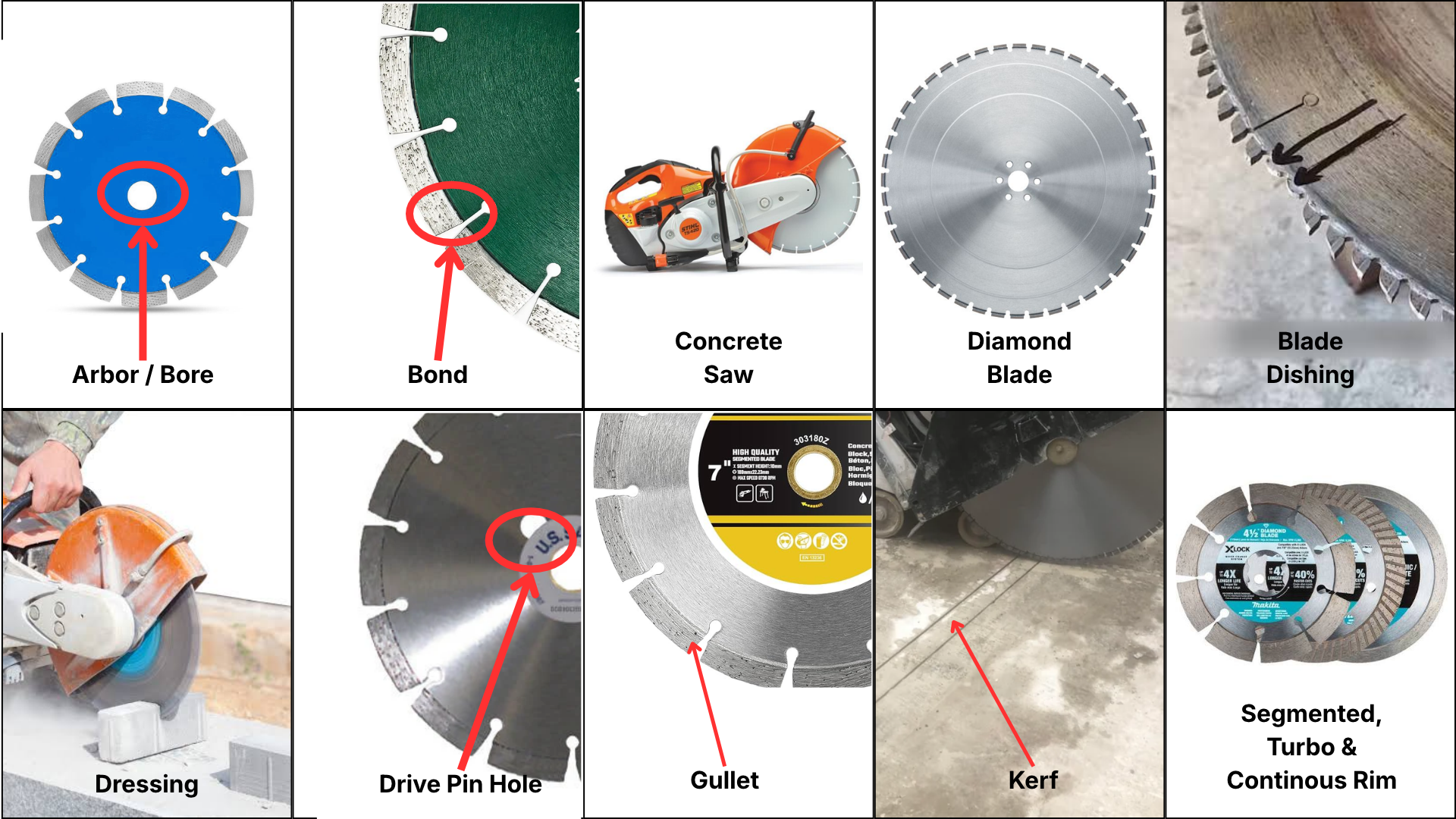
1. Arbor (Bore)
The arbor, also called the bore, is the center hole in a concrete saw blade. It fits over the saw’s spindle or shaft, allowing the machine to rotate the blade.
When choosing a blade, make sure its arbor size matches the saw. Some blades also have additional holes for drive pins.
2. Bond (Soft Bond and Hard Bond)
The bond is the metal matrix that holds the diamond particles inside a diamond blade’s segments. As the blade cuts, the bond gradually wears away and exposes fresh diamond particles.
There are two common bond types:
- Soft bond: Wears away more quickly, exposing new diamonds. It is generally used for cutting hard, dense materials.
- Hard bond: Wears away more slowly and holds the diamonds longer. It is generally used for cutting softer or more abrasive materials.
Choosing the correct bond helps maintain cutting speed and blade life.
3. Concrete Chainsaw
A concrete chainsaw is a specialized cutting tool that uses a diamond cutting chain instead of a circular blade. It is designed to make cuts in concrete, masonry, and other hard materials.
Concrete chainsaws are useful for cutting openings, corners, and areas where a traditional circular-blade saw may not reach.
4. Core (Steel Core)
The core, or steel core, is the circular metal body of a diamond saw blade. Diamond segments are attached around its outer edge to create the cutting surface.
The steel core provides structural support and helps the blade maintain its shape while rotating and cutting.
5. Diamond Blade
A diamond blade is a circular cutting blade with industrial diamond particles embedded in its cutting segments or rim. It is commonly used to cut concrete, asphalt, masonry, and other hard materials.
Diamond blades are available in different sizes, segment designs, and bond formulations. The right blade depends on the material, saw type, and cutting application.
6. Dishing / Warping
Dishing and warping describe two forms of blade deformation or wear.
- Dishing: The blade wears unevenly across its cutting surface, often causing the center or cutting area to become recessed.
- Warping: The steel core becomes distorted and no longer runs straight or true.
Both conditions can affect cutting accuracy and may indicate improper blade use, overheating, or excessive cutting pressure. Inspect a damaged or distorted blade before further use.
7. Dressing
Dressing is the process of exposing fresh diamond particles on a diamond blade’s cutting segments. It is usually done when the blade becomes glazed and stops cutting efficiently.
A blade may be dressed by cutting an appropriate abrasive material, following the blade manufacturer’s instructions. This helps remove worn bond material and expose new diamonds.
8. Drive Pin Hole
A drive pin hole is a small hole near the center of a concrete saw blade. It accommodates a drive pin on the saw’s blade flange.
The drive pin helps prevent the blade from rotating independently around the arbor. Make sure the blade’s drive pin hole is compatible with the saw before installation.
9. Glazing
Glazing happens when the metal bond on a diamond blade becomes smooth and covers the diamond particles. As a result, the blade may struggle to cut or become noticeably slower.
One common cause is using a bond that is too hard for the material being cut. Dressing the blade with a suitable abrasive material may help restore its cutting performance.
10. Gullet
A gullet is the space or slot between the diamond segments on a segmented blade. Gullets help water or air reach the cutting area, assist with cooling, and provide space for debris to escape.
Their design can affect blade cooling and cutting performance.
11. Kerf
Kerf refers to the width of the cut made by a concrete saw blade. It is also used to describe the width of the material removed during cutting.
For example, a wider blade segment generally creates a wider cut. Kerf matters when making precise cuts or fitting concrete sections together.
12. Laser Welded
Laser welded describes a method of attaching diamond segments to a steel blade core using a laser. The laser fuses the segment and core together to create a strong connection.
Laser welding is commonly used in the manufacturing of diamond blades, including many blades designed for dry cutting. Always follow the blade manufacturer’s instructions for the intended cutting method.
13. Segment (Segmented, Turbo, Continuous Rim)
A segment is the diamond-impregnated cutting section attached to the outer edge of a diamond blade. Segment design affects cutting speed, finish, cooling, and the type of material a blade can handle.
Three common designs include:
- Segmented: Has separate diamond segments with gullets between them. The gaps help with cooling and debris removal.
- Turbo: Has a serrated or notched rim designed to improve cutting speed and help remove cutting debris.
- Continuous rim: Has a smooth, uninterrupted cutting edge. It is commonly selected when a smoother finish is important.
14. Sintered
Sintered refers to a manufacturing process that uses heat and pressure to bond diamond particles with metal powders, forming the diamond segment.
This process creates the cutting section of many diamond blades. The metal mixture determines the bond characteristics and helps the blade perform in different materials.
15. Undercutting
Undercutting is the excessive wearing away of the steel core near the diamond segments. It can happen when abrasive material wears down the blade core faster than expected.
Undercutting can weaken the segment attachment area and contribute to premature segment loss. Using a blade designed for the material and application, along with appropriate cooling or undercut protection, can help reduce this problem.
2. Concrete Cutting and Joint Terms
16. Control Joint (Contraction Joint)
A control joint, also called a contraction joint, is a planned groove or cut in concrete that helps control where cracking occurs as the concrete shrinks during curing.
Concrete naturally shrinks as it dries and hardens. Control joints create a weakened plane so cracks are more likely to form along the intended line instead of appearing randomly.
17. Expansion Joint
An expansion joint is a gap or separation between concrete sections that allows the material to expand and contract as temperatures change.
Unlike a control joint, which encourages cracking at a planned location, an expansion joint separates concrete sections and provides space for movement. Expansion joints commonly contain flexible filler material.
18. Dry Cutting
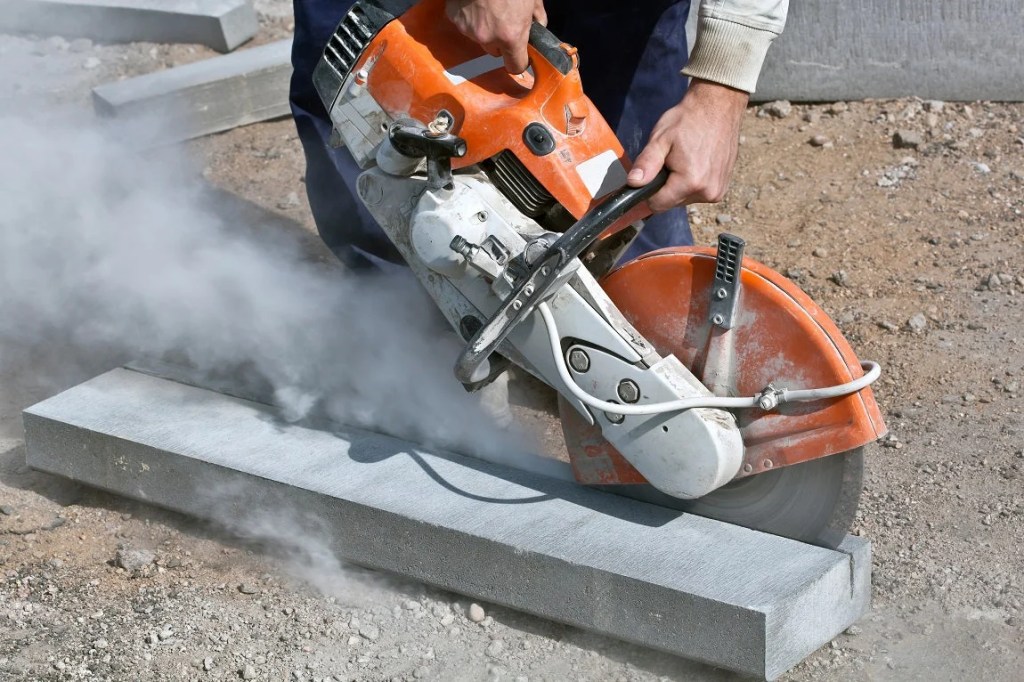
Dry cutting is a concrete cutting method performed without continuously supplying water to the blade.
This method is useful in applications where water cannot be used or is not practical. However, dry cutting can produce significant airborne silica dust. Appropriate dust-control equipment, such as a suitable dust collection system, must be used according to applicable safety requirements and the saw manufacturer’s instructions.
19. Green Concrete
Green concrete refers to freshly placed concrete that has not fully cured and hardened.
In concrete sawing, the term is especially relevant to early-entry cutting. Contractors may cut green concrete at a carefully selected time to create control joints before random shrinkage cracks develop.
20. Overcut
An overcut occurs when a saw blade cuts beyond the intended endpoint of a cut or joint.
It may happen when the operator continues cutting past the marked line or when a cut extends beyond the required intersection. Overcuts can damage adjacent concrete or affect the appearance and integrity of the finished work.
21. Plunge Cut
A plunge cut is made by lowering a rotating blade directly into the concrete surface rather than starting from an existing edge.
This technique is useful when creating openings or making cuts within a slab or wall. The saw must be designed and approved for plunge cutting, and the operator must follow the manufacturer’s procedures.
22. Silica Dust
Silica dust is fine airborne dust produced when cutting, grinding, or drilling materials that contain crystalline silica, including concrete.
Respirable crystalline silica is a serious workplace health hazard. Repeated exposure can cause silicosis and other respiratory diseases.
Water delivery and local exhaust ventilation are examples of engineering controls used to reduce exposure. Workers and employers should follow applicable silica safety requirements.
23. Slurry
Slurry is the wet mixture of water and concrete particles produced during wet cutting.
It often looks like muddy water and collects around the cutting area. Slurry should be collected and cleaned up properly. Allowing it to dry can release fine silica-containing dust back into the air.
24. Step Cutting
Step cutting is a technique in which a cut is made through multiple passes, gradually increasing the cutting depth rather than reaching the full depth in one pass.
This method can help manage cutting pressure and reduce stress on the blade and saw. The number and depth of passes depend on the equipment, blade, and material.
25. Pinching / Binding
Pinching or binding occurs when the concrete closes around the blade or otherwise traps it during cutting.
This can cause the blade to slow down or stop suddenly. It may also lead to kickback, blade damage, or loss of control.
Proper cutting technique, stable work conditions, and awareness of concrete movement can help reduce the risk.
26. Kickback
Kickback is a sudden reaction that occurs when a rotating blade or cutting chain becomes trapped, pinched, or catches on the material.
The saw can move unexpectedly, potentially toward the operator. Kickback is a serious hazard, especially when using handheld concrete saws and concrete chainsaws.
Always maintain a firm grip, use the correct cutting technique, and follow the equipment manufacturer’s safety instructions.
3. Types of Concrete Saws

27. Early-Entry Saw (Soff-Cut Saw)
An early-entry saw, commonly known as a Soff-Cut saw, is designed to cut control joints in concrete shortly after placement, while the concrete is still relatively green.
It helps contractors create joints before random shrinkage cracks develop. Early-entry saws typically use a specialized blade and skid plate system designed to minimize surface damage around the cut.
28. Hand-Held Cut-Off Saw
A hand-held cut-off saw is a portable power saw used to cut concrete, masonry, asphalt, and other construction materials.
It typically uses a circular diamond blade and is operated by hand. Handheld cut-off saws are useful for smaller cutting jobs, openings, and areas where larger equipment cannot easily operate.
29. Ring Saw
A ring saw is a specialized concrete cutting tool that uses a circular ring-shaped blade instead of a conventional disc blade.
Its design allows the cutting depth to extend closer to the blade’s full diameter, making it useful for deeper cuts than some traditional handheld saws of a similar size.
30. Walk-Behind Saw (Flat Saw)
A walk-behind saw, also known as a flat saw or floor saw, is a concrete cutting machine operated by an operator walking behind it.
It is commonly used for cutting horizontal surfaces such as concrete floors, roads, bridges, and pavement. Walk-behind saws are often used to create control joints, cut trenches, and remove sections of concrete.
31. Wall Saw (Track Saw)
A wall saw, also called a track saw, is a concrete cutting machine mounted on a track or rail secured to a wall, floor, or other structure.
The track guides the saw along a controlled path, allowing accurate cuts in vertical and inclined concrete surfaces. Wall saws are often used to create door openings, window openings, and other large structural cuts.
32. Wire Saw (Diamond Wire Saw)
A wire saw, also called a diamond wire saw, uses a flexible cable fitted with diamond beads to cut through concrete and other hard materials.
Unlike a conventional circular blade, the wire can wrap around large structures and cut irregular shapes. It is commonly used for thick concrete sections, bridges, foundations, and large structural demolition projects.
4. Cutting Methods and Safety Terms
33. Wet Cutting

Wet cutting is a concrete cutting method that uses water supplied to the blade during operation.
The water helps cool the blade and suppress airborne dust. It also helps flush concrete particles away from the cutting area.
Wet cutting is widely used in concrete sawing, but operators must manage water, electrical hazards where applicable, and the resulting slurry. Water flow should follow the saw and blade manufacturer’s recommendations.
5. Frequently Asked Questions About Concrete Saw Terminology
What is the difference between a concrete saw and a cut-off saw?
A concrete saw is a general term for equipment designed to cut concrete. A cut-off saw usually refers to a portable handheld saw with a circular cutting blade. A cut-off saw is one type of concrete saw, but concrete saws also include walk-behind saws, wall saws, ring saws, and wire saws.
What is the difference between a soft bond and a hard bond diamond blade?
A soft bond blade wears down more quickly to expose fresh diamonds, making it suitable for hard, dense materials. A hard bond blade wears more slowly and is generally better suited for softer or more abrasive materials.
What is the difference between wet cutting and dry cutting?
Wet cutting uses water to cool the blade and reduce airborne dust. Dry cutting does not use a continuous water supply and generally requires an appropriate alternative dust-control method.
What is the difference between a control joint and an expansion joint?
A control joint creates a planned weak point where concrete can crack as it shrinks. An expansion joint creates separation between concrete sections so they can move as temperatures change.
What is the purpose of a gullet on a diamond blade?
A gullet is the space between diamond segments. It helps air or water reach the cutting area and allows debris to escape during operation.
Why does a diamond blade become glazed?
A diamond blade becomes glazed when the bond does not wear away effectively, leaving the diamond particles covered or unable to cut efficiently. This can happen when the blade’s bond is too hard for the material being cut. Dressing the blade may help expose fresh diamonds.
Final Thoughts
Understanding concrete saw terminology makes it easier to choose the right equipment, identify blade problems, and communicate effectively on the jobsite. Whether you are working with diamond blades, handheld cut-off saws, walk-behind saws, or wall saws, knowing these terms can help you make more informed equipment decisions.
If you need help with construction equipment parts or equipment service, TexPro Equipment can help. Visit our Parts Sales page to explore parts support, or learn more about our Equipment Service Center.
You can also contact TexPro Equipment at 817-834-5800 for assistance.




Leave a Reply