

How DFW Contractors Can Reduce Equipment
Downtime During Busy Season
During peak season, construction companies in Dallas-Fort Worth face many challenges. Construction equipment downtime delays workers, increases labour costs, throws off project timelines, and pressures companies to complete work with the limited equipment available. To prevent downtime, contractors who use the most efficient methods can maintain their equipment in advance and deter major issues from occurring in the first place.
Instead of completely eliminating equipment failure, contractors should expect common failures to happen and learn how to handle impending issues before they develop into bigger problems.
Table of Contents
- Busy-Season Equipment Downtime: Why Preparation Matters
- Keep Maintenance Parts on Hand
- Do Weekly Equipment Checks
- Schedule Service Before Peak Use
- Use Field Service for Practical Repairs
- Bring Major Repairs to the Shop Early
- Track Repeat Failures
- Build a Busy-Season Equipment Maintenance Plan
- Busy-Season Equipment Checklist
- Conclusion
- FAQs
Busy-Season Equipment Downtime: Why Preparation Matters
| Common Problem | What It Can Cause | Best Preventive Action |
| Worn belts or hoses | Sudden breakdown | Inspect and replace before peak use |
| Low fluid levels | Overheating or component damage | Check fluids weekly |
| Missing replacement parts | Longer repair delays | Keep critical parts in stock |
| Repeated equipment failures | Recurring downtime | Track repair history |
| Major repairs discovered late | Project interruptions | Schedule shop repairs early |
| Jobsite breakdowns | Crew and schedule delays | Use field service when practical |
Busy-Season Equipment Maintenance: 7 Ways to Reduce Downtime
1. Keep Maintenance Parts on Hand
One of the simplest ways to prevent repair delays is to maintain an inventory of commonly needed parts. Filters, belts, hoses, seals, fittings, and other service components can often be replaced quickly when they are already available.
Contractors should review the service history of frequently used machines and identify parts that are regularly replaced. Keeping these items on hand can reduce waiting time when a problem occurs.
A basic parts inventory is particularly useful for equipment that is essential to daily operations. Instead of waiting for a part to arrive after a failure, crews can begin the repair sooner and reduce construction equipment downtime.
2. Do Weekly Equipment Checks

The meaning of the original text should be retained while changing phrasing.
Weekly inspections allow operators and maintenance personnel to catch minor issues before they turn into high-cost breakdowns.
Basic inspection entails:
● Verifying engine oil and hydraulic fluid levels
● Searching for leaks
● Examining belts and hoses
● Looking over tires, tracks, and components of the undercarriage
● Checking filters and visible connections
● Listening for telltale noises
● Checking lights, controls, and safety equipment
Operators should be keen to note any changes in the operation of their machines, such as loss of power, vibrations, overheating, or difficulties in starting.
Regular inspections are a practical part of construction equipment maintenance in DFW, especially when machines are working long hours during peak project periods.
3. Schedule Service Before Peak Use

Waiting until equipment breaks down is rarely the best maintenance strategy. Contractors should review upcoming projects and schedule preventive service before machines enter their busiest operating periods.
Service may include fluid changes, filter replacement, lubrication, inspections, adjustments, and replacement of worn components. Planning this work in advance gives contractors greater control over when equipment is unavailable.
Preventive maintenance can also reveal repairs that need additional attention. Addressing these problems before peak use can help reduce construction equipment downtime when crews are working under tight deadlines.
Quick Fact: According to the U.S. Department of Energy, predictive maintenance can reduce maintenance costs by 25%–30% and eliminate breakdowns by 70%–75% when compared with reactive maintenance approaches.
4. Use Field Service for Practical Repairs

There are times when equipment problems can be resolved without going to a repair shop. In those cases, field service makes sense. There are various inspections, part replacements, troubleshooting, hydraulic repairs, electrical issues, and other types of service for construction equipment that can be performed with the help of proper equipment and technicians.
In-person repairs allow the work to be done without wasting time and money transporting the machinery. For contractors that work in the DFW region, repairing equipment on-site gives them a chance to resume work faster.
TexPro Equipment offers construction equipment service solutions for contractors in the DFW area.
Need field service help in your work area? TexPro Equipment is ready to respond.
5. Bring Major Repairs to the Shop Early
Some repairs are better suited to a professional repair shop. Major engine work, extensive hydraulic repairs, complex electrical problems, significant disassembly, and repairs requiring specialized diagnostic equipment may take longer and require a controlled shop environment.
Contractors should not wait for a major failure if an inspection already shows that substantial work is needed. Moving equipment to the shop early allows technicians to diagnose the problem, source necessary parts, complete the repair, and test the machine before it is urgently needed.
This approach can prevent a machine from failing in the middle of an important project and help contractors manage DFW construction equipment repair more efficiently.
Planning a major equipment repair? Contact TexPro Equipment early to schedule professional repair service and help prevent unexpected downtime during your busiest projects.
6. Track Repeat Failures
A machine that repeatedly develops the same problem deserves closer attention. Simply repairing the failed component each time may not address the underlying cause.
Contractors should keep records of:
● Equipment model and operating hours
● Date of each repair
● Failed components
● Parts replaced
● Type of repair performed
● Recurring symptoms
● Technician recommendations
Reviewing these records can reveal patterns. For example, repeated hose failures may point to routing, vibration, pressure, or installation problems. Frequent electrical issues may indicate a larger system problem.
Tracking repeat failures helps contractors decide when continued repairs make sense and when a more comprehensive inspection or repair is necessary. It can also reduce construction equipment downtime caused by recurring issues.
7. Build a Busy-Season Equipment Maintenance Plan
A simple maintenance plan can help contractors prepare equipment before demand increases. Start by identifying machines that are critical to upcoming projects and reviewing their maintenance and repair history.
Next, create a schedule covering inspections, preventive service, parts inventory, field repairs, and shop repairs. Give priority to machines that would cause the greatest project disruption if they failed.
Contractors should also establish a clear process for reporting equipment problems. Operators need to know who to contact when they notice warning signs, while maintenance teams should know how to determine whether a machine requires immediate attention.
Combining regular inspections with planned repairs can make construction equipment downtime easier to manage during busy periods.
Busy-Season Equipment Checklist
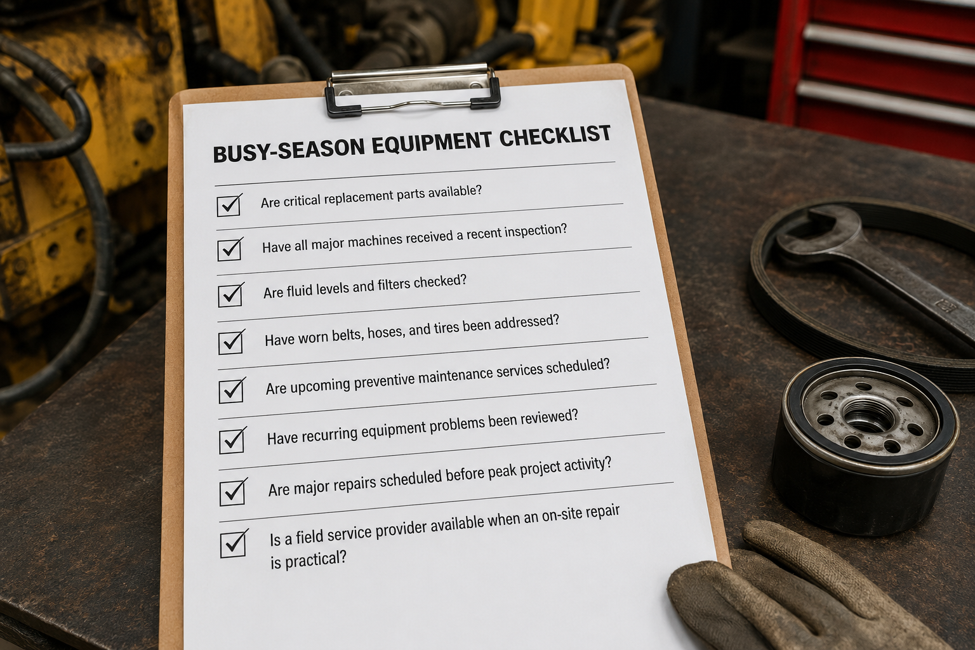
Before entering a heavy construction period, contractors should ask:
- Are critical replacement parts available?
- Have all major machines received a recent inspection?
- Are fluid levels and filters checked?
- Have worn belts, hoses, and tires been addressed?
- Are upcoming preventive maintenance services scheduled?
- Have recurring equipment problems been reviewed?
- Are major repairs scheduled before peak project activity?
- Is a field service provider available when an on-site repair is practical?
Conclusion
Busy construction seasons leave little room for unexpected equipment problems. Contractors can reduce disruptions by preparing before machines reach their heaviest workloads.
Keeping common maintenance parts available, performing weekly inspections, scheduling service early, using field service for practical repairs, sending major repairs to the shop before they become emergencies, and tracking repeat failures can all contribute to more reliable equipment.
A proactive approach helps contractors spend less time reacting to breakdowns and more time keeping projects moving.
Don’t let a preventable breakdown slow down your next project. Keep your equipment ready for the busy season with professional parts, field service, and repair support from TexPro Equipment. Call 817-834-5800 to schedule service and keep your projects moving.
FAQs
1. How can contractors reduce equipment downtime during busy season?
Contractors can reduce downtime by performing regular inspections, completing preventive maintenance before peak use, keeping common parts available, tracking repeat failures, and addressing major repairs early.
2. When should construction equipment receive preventive service?
Equipment should be serviced according to the manufacturer’s maintenance schedule and before periods of heavy or extended use. Contractors should also schedule service when inspections identify worn or failing components.
3. Is field service better than taking equipment to a shop?
It depends on the repair. Practical repairs that can be safely completed at the jobsite may be suitable for field service, while major repairs requiring extensive disassembly or specialized equipment are generally better handled in a shop.
4. What equipment problems should contractors address immediately?
Fluid leaks, overheating, unusual noises, warning lights, hydraulic problems, significant vibration, starting issues, and sudden performance changes should be investigated promptly to prevent more serious failures.
5. Why should contractors track repeat equipment failures?
Tracking repeat failures helps identify patterns and potential underlying problems. This information can help maintenance teams determine whether a component needs replacement, a system requires further diagnosis, or a larger repair should be scheduled



Leave a Reply